Thursday, January 28, 2016

New York State Archives is hiring an Archives and Records Management Specialist 2

If you're an archivist or records manager who has substantial technical skills and knowledge of various metadata standards, wants to work for a darned good archival program, isn't afraid of occasionally working with me (I don't bite, I promise), and would like to live in a small yet colorful upstate New York city, the New York State Archives may have a job for you:
The New York State Archives is seeking to fill an Archives and Records Management Specialist (ARMS) 2 position within the Information Services Unit. The Information Services Unit has responsibility for the development, integration, and support of all New York State Archives information systems. Under the direction of an Archives and Records Management Specialist 3, duties of this position include, but are not limited to, the following:
Participate in the implementation, maintenance and integration of public access and records management systems; Develop and manage New York State Archives web site content relating to government records services and to archival collections; Provide advisement on the implementation of archival professional standards, including but not limited to EAD, EAC, Dublin Core and TEI; Work with State Archives staff and vendors to identify and implement web-based solutions; and Support development of the New York State Archives electronic records program.

MINIMUM QUALIFICATIONS
For permanent appointment candidates must have one year of permanent competitive or non-competitive 55b/c service as an Archives and Records Management Specialist 1 OR have one year of permanent competitive or 55b/c service in a title SG-16 or above in a title deemed eligible for transfer under Section 52.6 of the Civil Service Law. In addition, candidates must also possess the qualifications listed below. For provisional appointment, candidates must have a Master's degree in history, government, business or public administration, political science, American studies, library/information science, or archival administration and two years of professional experience in which the majority of duties involved one or more of the following:
  • Analyzing or appraising records and information systems to develop recordkeeping and/or records retention plans for an institution, governmental body, or corporation; 
  •  Providing education, training, grant-in-aid, or direct technical assistance services in records management and/or archives administration for an institution, governmental body, or corporation; 
  • Developing or implementing guidelines, standards, policies and procedures concerning records management and/or archives administration for an institution, governmental body, or corporation; 
  • Evaluating available information technology to support recordkeeping needs and requirements of an institution, governmental body, or corporation; 
  • Acquiring, controlling, preserving, making available, or promoting use of archival records, whether in electronic, paper, or other form for an institution, governmental body, or corporation. 
PREFERRED QUALIFICATIONS
Special consideration will be given to candidates who possess the following qualifications:
  • Participation in the implementation/maintenance of public access and/or records management systems. 
  • Participation in the implementation/maintenance of websites. 
  • Knowledge and understanding of the standards used to provide access to and manage archival records including EAD, EAC and TEI. 
  • Familiarity with XML, XSL and XLST. 
  • Demonstration of experience with core archival and records management practices including scheduling/appraisal; archival description and preservation; digital preservation and electronic records; references services to a wide range of users including state and local government agencies, academics, educators, genealogists, local historians, and the general public. 
The starting salary for this position is $52,293 and, at least according to the current salary schedule, the salary will gradually increase to $66,494 based on annual performance advances. These figures are established by a collective bargaining agreement and are non-negotiable; they may also change slightly following the next round of contract negotiations. In addition, the State of New York offers a comprehensive array of retirement, health, and other benefits.

The deadline for applying for this position is 9 February 2016. For more information and application instructions, consult the position description.

Wednesday, January 27, 2016

Oregon State Archives seeks a Records Analyst 1

Are you an experienced electronic records archivist or electronic records manager? Do you relish the thought of ensuring the continued development of a successful, statewide electronic records management system? Do you live or want to live in the Pacific Northwest? If you answered "yes" to all of these questions, the Oregon State Archives may have a job for you:

This position advises and assists state and local government agencies in records management. This is accomplished in part, but not limited to:
  • Design business processes, record types, records classifications and work flow strategies for the maintenance, access and retrieval of data in the Oregon Records Management Solution (ORMS). 
  • Act as point of contact for the day-to-day operations of the Oregon Records Management Solution. Develop methods for quality control of the Oregon Records Management Solution. 
  • Coordinate the creation, maintenance, retrieval, protection, retention, storage and disposition of all records (electronic and manual) in accordance with State Policy and legal, financial, governmental and historical requirements. 
  •  Provide training and general assistance to state and local government agencies regarding effective records management practices. 
  • Demonstrate continuous effort to improve operations, work cooperatively with internal and external customers and provide quality seamless customer service. 
  • Research and write administrative overviews and program descriptions of state and local government agencies when a schedule is developed or revised providing history and current status. 
In order to be considered for this position, you must have:
  • A Master’s Degree in history, public administration, archives and records administration or a related degree that demonstrates the capacity for the knowledge and skills AND 
  • One year of professional level experience in records management or archives
 OR
  • A Bachelor’s degree in history, public administration, archives and records administration or a related degree that demonstrates the capacity for the knowledge and skills AND 
  • Designation as a Certified Records Manager (CRM)
The salary range for this position is $3,365 - $4,899 per month, and the application deadline is 2 February 2016. For more information about this job, the Oregon State Archives, fringe benefits, and the Salem area, consult the very attractive position description.

Tuesday, January 26, 2016

Ohio History Connection seeks an Electronic Records Archivist

If you have both electronic records management and digital preservation experience and want to live in a Midwestern city that's surprisingly energetic and appealing, the Ohio History Connection would like to hear from you. (I'm an Ohio native, so I'm allowed to say that Columbus -- a city I've repeatedly enjoyed -- is a lot more more interesting that it seems at first glance.) Here's what you need to know:
Summary
This position within the State Archives is responsible for the appraisal, transfer, accessioning, management, description, preservation and access of electronic public records acquired by the State Archives of Ohio.

Essential Duties and Responsibilities
  • In consultation with the State Archivist, establish and implement electronic records policies, goals and objectives. 
  • Carry out professional archival work focused on the appraisal of, description of, preservation of and access to electronic records transferred to the State Archives. 
  • Review options and make recommendations for the accessioning, ingest, potential conversion, storage, preservation of and access to electronic records transferred to the State Archives. 
  • Assist in the development of records retention and disposition schedules for government records.  
  • Develop and deliver training on electronic records management and preservation. 
  • Serve, as required, on national and statewide working groups, committees and task forces such as the Ohio Electronic Records Committee. 
  • Serve as liaison between the State Archives and the Ohio History Connection Information Technology staff. 
  • Other duties as assigned. 
Supervisory Responsibilities
The Electronic Records Archivist supervises staff archivists in their duties of appraisal, preservation, arrangement and description of electronic records as well as the associated processing efforts of interns and volunteers. Qualifications Education and Experience:

Required:
  • Master’s degree in library science, archival administration or information technology. 
  • Thorough knowledge of electronic archival and records management principles and practices. 
  • Understanding of archival systems, document imaging and conversion systems, document management systems, and records management. 
  • Knowledge of metadata standards.
  • Experience with electronic records preservation activities.
  • Excellent project management skills and ability to carry out essential job requirements and produce efficient and effective results. 
Preferred
  • A minimum of four years of records management and/or archival experience and relevant experience managing a successful electronic records program.
  • Experience appraising government records.
  • Experience conducting archival training and outreach.
  • Working knowledge of state and local government organizational structures, operations and functions. 
Certificates or Licensures
Must possess valid driver’s license. Certified Archivist or Certified Records Manager designations, Society of American Archivists Digital Archives Specialist or Certified Document Imaging Architect (CDIA+) certifications preferred.

Language Skills
Ability to follow complex written or oral instructions. Must be able to effectively explain complex records management, archival and information technology issues to non-technical audiences, including staff, associates, government entities and the public orally and in writing.

Mathematical Skills
Requires basic mathematical skills.

Technical Skills
Must have a comprehensive knowledge of archival and records management techniques, electronic records management and preservation practices, document imaging and management systems, and emerging electronic technologies.

Reasoning Ability
Ability to pay attention to detail. Ability to determine and employ the most efficient and effective methods in order to achieve desired results.

Note
Position will remain open until filled. All interested applicants should submit a professional cover letter, resume with salary requirements to: applicant[at]ohiohistory.org or fax to Human Resources at 614-297-2293.

Contact
Human Resources Office
Ohio History Connection
800 E. 17th Ave. Columbus, OH 43211
Fax: 614-297-2293
E-mail: applicant[at]ohiohistory.org

Wednesday, October 21, 2015

Best Practices Exchange: day three

Memorial Hall, Pennsylvania State Museum, Harrisburg, Pennsylvania, 21 October 2015.
The 2015 Best Practices Exchange (BPE) ended just before noon today. I spent most of the afternoon and early evening driving home, and I need to spend the rest of this evening unpacking and getting ready to go to work tomorrow, so I'm going to put up a few more substantive posts in the coming days. However, one of the things that I love about the BPE is that it often makes one look for connections between seemingly disparate things, and this morning I took a look around the museum and noted that our very surroundings seemed to be reinforcing points made in various presentations.

This year's BPE sessions took place in the Pennsylvania State Museum building, and attendees repeatedly passed through the Museum's Memorial Hall, which is dedicated to the vision of Pennsylvania founder William Penn as they made their way from one session to the next. Memorial Hall features a mammoth, strikingly modernist sculpture of Penn, a reproduction of Pennsylvania's original colonial charter, and a mural by Vincent Maragliotti depicting the state's history from the colonial era to the mid-1960s.

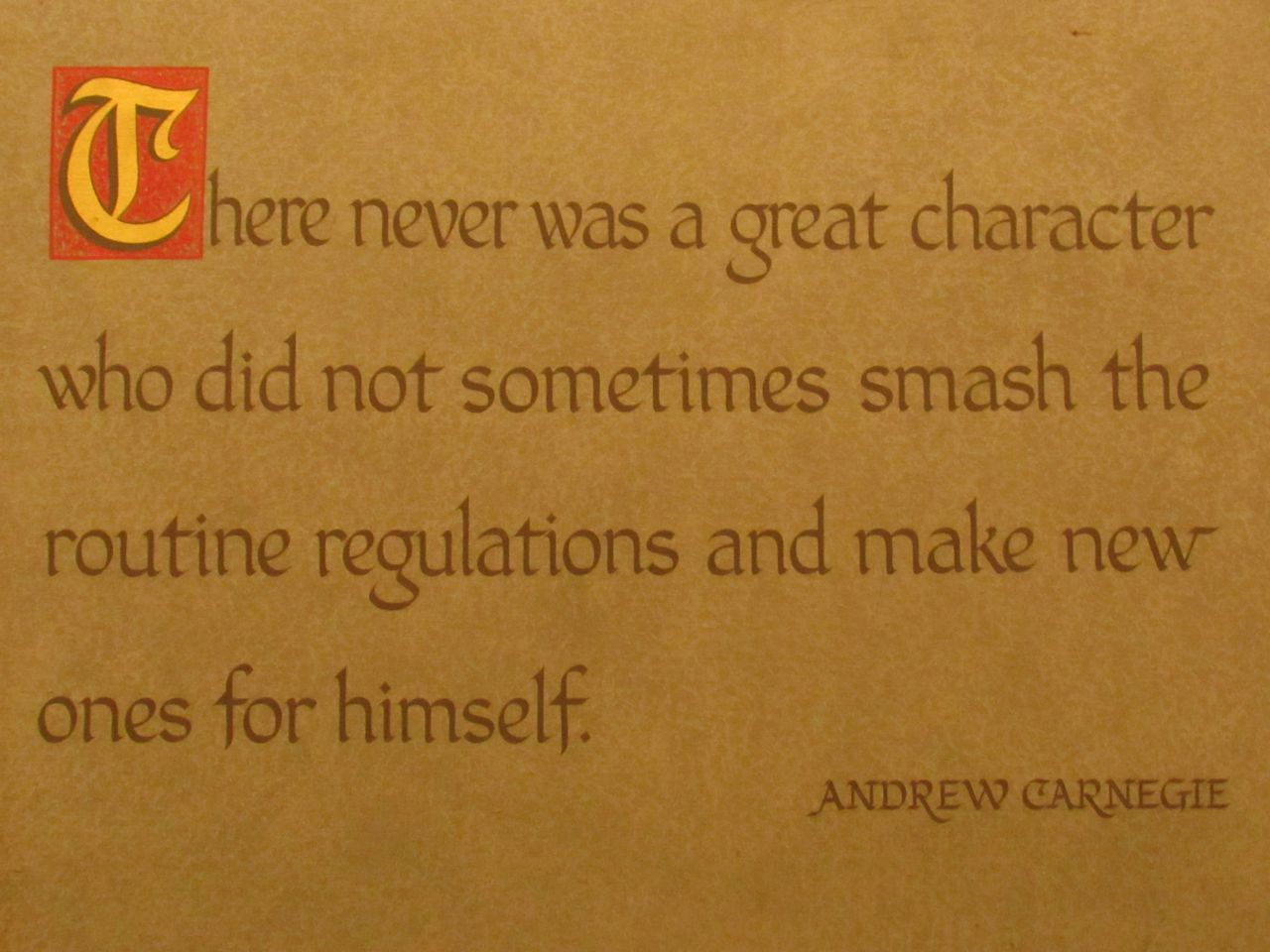
Painted beneath the mural are quotations from over a dozen prominent Pennsylvanians. I scanned them this morning as I was heading to a session, and several of them seemed strikingly resonant.

 BPE attendees tend to be thoroughly practical, in part because we've all seen large-scale information technology projects end miserably. Doug Robinson, the executive director of the National Association of State Chief Information Officers, noted during a plenary address that the spectacular failure of numerous government IT projects -- failures rooted in the desire to solve all problems at once and in repeated changes in project scope and direction -- is finally moving state CIOs toward an agile, incremental approach to software and system development.

The BPE exists because archivists, librarians, and other people recognize that the processes and policies that worked so well in an analog world don't work so well in the digital era. This year, many presenters detailed how they're developing and documenting new processing workflows and drafting new preservation and records management policies. We're creating these things not because we wish to sow discord or promote ourselves but because our mission -- preserving and providing state government and other born-digital content -- demands it of us.

BPE attendees have always stressed that failure can be just as instructive as success, and Kate Theimer stressed in her plenary address that we need to create organizational cultures in which failure is recognized as part and parcel of innovation. I would argue that demonstrating a certain degree of compassion is part and parcel of this effort. Most of the people who self-select to become archivists and librarians were conscientious students who took pride in having the "right" answer, and we have to keep gently reminding our perfectionist peers that failure itself is neither unusual nor a sign of incompetence. Failure to learn from a failure is far more damaging.

I don't know whether the "irresistible right arm shall divide the waves," but as Pennsylvania State University records manager Jackie Esposito emphasized in this morning's plenary address, those of us who are actively grappling with digital preservation and electronic records management are doing so in part because the risks associated with not doing so -- financial losses, legal sanctions, tarnished institutional reputations, inability to conduct business -- are even greater than the risks associated with wading into the deep waters of digital preservation and electronic records management. We don't have any choice but to keep going forward, even if the only right -- or left -- arms pushing against the waves are our own.

Tuesday, October 20, 2015

Best Practices Exchange 2015: day two

Utility marking in front of the Pennsylvania State Capitol Complex, North Third Street, Harrisburg, Pennsylvania, 20 October 2015
The experiences I had today at the 2015 Best Practices Exchange (BPE) highlighted highlighted precisely why I love this conference so much: I listened as other people shared some thought-provoking insights, discussed how my own institution is addressing some electronic records challenges and encouraged others to share how their organizations are tackling the same problems, learned about some great new tools and their uses, and spent lunch and dinner catching up with friends I rarely get to see.

It's late, tomorrow's plenary starts at 8:30 AM, and as a result I'm going to devote this brief post to Kate Theimer's incisive plenary presentation. Kate's planning to post the full text of her talk -- and, perhaps, the full text of an alternate version she opted against writing for the BPE -- on her own site, and I don't want to steal her thunder. As a result, I'm simply going to underscore what, in my view, was her most essential point:

Archivists don't set out to be innovative, and "innovation" isn't the preserve of the library or archival profession's elite. Innovation is what happens when we try to figure out how we can do our jobs more effectively. In most instances, innovation occurs when we're confronted with some sort of problem or challenge and decide that we're going to try to do something about it. If you've figured out some way to improve your organization's processes or services, you're an innovator -- even if your solution is less than perfect.

Good night.

Monday, October 19, 2015

Best Practices Exchange 2015: day one

Light fixture, Pennsylvania State Museum, Harrisburg, Pennsylvania, 19 October 2015.
The 2015 Best Practices Exchange (BPE) got underway at the Pennsylvania State Museum in Harrisburg earlier today. The BPE is a conference that brings together archivists, librarians, information technologists, and other people who seek to preserve born-digital state government information, and it emphasizes sharing lessons learned (i.e., lessons taught by failure) as well as success stories. It's my favorite conference, and I always leave the BPE feeling energized and inspired.

I'm a little under the weather and am still thinking through some of the things I heard about today, so this post is going to be brief. However, I did want to pass on something that really piqued my interest:
  • A group of Michigan archivists and librarians doing hands-on digital preservation work have formed a grassroots organization, Mid-Michigan Digital Practitioners, that meets twice a year to exchange information. The group has no institutional sponsor, has no formal leadership structure, and charges no membership dues; however, the website of Michigan State University's Archives and Historical Collections includes information about and presentations delivered at past meetings. Mid-Michigan Digital Practitioners has capped its size in an effort to ensure that it remains small enough to allow members to form a tightly knit, geographically concentrated community of practice, and I think that this is a good thing. Local and regional professional organizations and regional, national, and international communities of practice are all incredibly valuable, but local, less formalized communities can propel enduring collaboration and can be far less intimidating to people who are just beginning to grapple with digital preservation issues. I would love to see lots of little, unstructured, and locally based digital preservation groups pop up all over the place.
I also want to share a couple of key points that a pair of experienced professionals made about making the case for electronic records management and digital preservation:
  •  The technologies we will use to manage and preserve archival records are the same technologies we will use to preserve records that are not permanent but which have lengthy retention periods. When making the case for digital preservation to CIOs and other high-ranking, we should consider focusing less on the former and emphasizing that we can help care for the latter. If we create an environment in which people are comfortable sending records that have long retention periods to an archives-governed storage facility -- just as they are currently comfortable sending paper records that have long retention periods to a different archives-operated storage facility -- we can easily take care of preserving those records that warrant permanent preservation.
  • All too often, we think in terms of what records creators must do in order to comply with regulations, laws, or records management best practices. We should instead assess the environment in which records creators operate, identify the problems with which creators are struggling, and then stress how we can help to solve these problems.
 Finally, one attendee made a comment that struck me as being so basic that it's often overlooked:
  • When we talk about "electronic records," many people simply assume that we're advocating scanning paper documents and then getting rid of all paper records. We need to make sure that people understand that we're focusing on those materials that are created digitally and will be managed and preserved in digital format. How do we do this?
More tomorrow.

Monday, August 24, 2015

SAA 2015: Cleveland Digital Public Library

Main lobby, Cleveland Public Library, East 3rd Street and Superior Avenue, Cleveland, Ohio, 2015-08-22. This is what a library should look like.
The annual meeting of the Society of American Archivists ended early Saturday afternoon. I then visited the main branch of the Cleveland Public Library. I fell in love with this library as an undergraduate, and I was pleased to see that the original building, a Beaux Arts beauty, has received some much needed care and that a sparkling 21st century addition now sits immediately to the east of the library's reading garden.

I was particularly pleased to discover that earlier this year, the library launched the Cleveland Digital Public Library, which supports digitization of historically significant materials owned by the Cleveland Public Library, other cultural heritage institutions, and organizations and individuals in the Cleveland area. Cleveland was one of four large public libraries that received Library Services Technology Act and Ohio Public Library Information Network funding that supported the purchase of high-resolution scanning equipment and storage, and Cleveland's program is unique in that it allows community members to use its scanning equipment and to add copies of the resulting image files to the library's permanent digital collections.

I know that the Cleveland Public Library isn't the first institution to create and maintain digital images of manuscript and archival materials that remain in the hands of their creators, but it may be unique in that it puts community members in charge of determining whether their materials should be added to the library's collections and enables them to create and donate copies of their materials at their convenience. Almost all of the other "scan and add" projects with which I'm familiar have sought to collect copies of materials that focused on a given event (e.g., the Civil War) and make their scanning services available to community members for only a few hours or a few days at a time.

I imagine that, in at least a few instances, the community-created images added to the Cleveland Public Digital Library's collections will strike archivists, librarians, and other members of the community as less than preservation-worthy. However, judging from the videos embedded in the Cleveland Digital Public Library's web page, this program will help to ensure that some fascinating Cleveland lives and stories are preserved and made broadly accessible. It pleases me deeply that the Cleveland Public Library is taking a 21st century approach to collecting and facilitating access to the city's historical record.