Saturday, February 23, 2013

New York in Bloom 2013, part one

New York in Bloom, the New York State Museum's annual fundraiser for its after-school programs, is being held this weekend.  Those of you who have been following this blog for a bit know that I'm a huge fan of this event, which brings some much-needed color and fragrance to a bleak month.  When it arrives, I stop blogging about records, digital preservation, and archives for a few days and devote a couple of days to writing about flowers and the exhibits created by my employer's sister institution. 

Those of you who know about New York in Bloom may also know that the Museum Club (8-13 years old) and Discovery Squad (14-18 years old) have given invaluable educational, social, and vocational support to young people from some of Albany's most hardscrabble neighborhoods.  Each and every Discovery Squad student has graduated from high school -- no small accomplishment given that Albany High School's 2011 graduation rate was an appalling 52.3 percent -- and 92 percent have been admitted to college.  If you're going to be in the Albany area tomorrow, please consider attending New York in Bloom and supporting these fine programs.

This is the fourth year I've blogged about New York in Bloom, and I have to say that the floral arrangements, which are created by floral designers, students, garden clubs, and individual hobbyists, are a little less extravagant than in years past.  For example, the Bird Hall, which in past years was home to sextets of mammoth floral roomscapes, is completely devoid of arrangements this year.  However, the stunning "Once Upon a Time" arrangement that David Michael Schmidt of Renaissance Floral Design created for the main lobby of the Cultural Education Center (which houses the State Archives and State Library as well as the State Museum) is one of the lushest and most ornate things I've ever seen.

This is the fourth year I've blogged about New York in Bloom, and I have to say that the floral arrangements, which are created by floral designers, students, garden clubs, and individual hobbyists, are a little less extravagant than in years past.  For example, the Bird Hall, which in past years was home to sextets of mammoth floral roomscapes, is completely devoid of arrangements this year.  However, the stunning "Once Upon a Time" arrangement that David Michael Schmidt of Renaissance Floral Design created for the main lobby of the Cultural Education Center (which houses the State Archives and State Library as well as the State Museum) is one of the lushest and most ornate things I've ever seen.  This fairy tale-themed installation features several artifacts from the State Museum's collections, including a flax wheel made ca. 1830 by R. Werdon.

Note the bitten apple to the left of the "carriage," which is actually a 19th-century glass hearse that was formerly part of a private collection in Greenville, New York.

The glass slipper and gown were created for the now-defunct New York Theater Institute, which used them in several early 21st-century productions.

My photographs of this display really don't do justice to this installation, but this professionally produced video documenting its creation most certainly does.

The State Museum sometimes uses the corridor leading to the West Gallery to exhibit a large artifact or grouping of photographs, but at the moment the corridor is devoid of any exhibit materials.  As a result, the arrangements placed there really pop out.  Holly Hemming of Felthausen's Florist created this delightfully springlike arrangement of liatris, iris, blue hydrangea, button mums, and blue delphinium. It's one of my favorites.

I'm a sucker for white flowers and green foliage. Jessica Morgan, the Gardener of the City of Albany, used calla lilies, green hydrangea, bells of Ireland, green spider mums, green cymbidium orchids, and snapdragons for this grouping.

The West Gallery itself is a temporary exhibit space. At the moment, it's home to Eugene Ludins:  American Fantasist (open until 13 May 2013).  This commanding arrangement forsythia, amaryllis, Monstera deliciosa, aspidistra, and bear grass, which was created by On Thai of Surroundings Floral, stands at its entrance.

The western wing of the State Museum is devoted to the natural and early history of the state.  For the past few years, part of it has been home to Beneath the City:  An Archaeological Perspective of Albany.  Stacy Collins of Fleurtatious Designs created an arrangement of Gerbera daisy, liatris, larkspur, iris, delphinium, daffodil, and amaryllis bulbs that looks right at home in it.

I really like this grouping of leather leaf, lemon leaf, snapdragon, sunflowers, alstromeria, solidago, and facsimile historical records that Stephanie Elicia Powers of the Capital Region Career and Technical School placed right in front of two mammoth barrels that were found at the site of the Quackenbush-Douw-Bogaert rum distillery, which was established in 1758-1759.  However, I couldn't help but think -- and not for the first time -- that the City of Albany and the State of New York just don't think things through.  Albany is one of the oldest European cities in North America.  It's been continuously settled since 1624 (four years after the Mayflower!) but the powers that be don't recognize that the city's past is both unique and immensely valuable.  The Commonwealth of Virginia recognizes that the history of Jamestown (settled a mere 17 years before Albany) is a huge tourist draw, and visitors to Jamestown see active archaeological digs and visit an archaearium that features some of the most compellingly interpreted exhibits I've ever seen.  What did the City of Albany do when the Quackenbush-Douw-Bogaert distillery was unearthed as a result of a construction project?  It let the State Museum and an area architectural firm access to the site -- for a few months.  It then finished building a six-story parking garage on the site.  I realize that Jamestown is currently inhabited by only a few people and that Albany is still a (semi-)functioning city, but no one with any amount of power seems interested in capitalizing upon, not burying, Albany's fascinating past.

Most of the State Museum's western wing is devoted to the Adirondacks, and as a result many of the arrangements found within it have a decidedly woodsy look.  I particularly like this Asian-influenced grouping of echeveria, lily, liatris, bells of Ireland, moss, and orchids, which was created by Craig Waltz of Fleurelite Floral Design.

Christopher Grigas of Fleurtacious Designs used phalaenopsis orchids, reindeer moss, magnolia leaf skeletons, and spruce, ash, and birch branches to create a subtle arrangement that splendidly complements a mammoth photographic image of Adirondack forest land.

As impressive as it looks from a distance, this arrangement really rewards close viewing.

Rich Coogan of the Bill Doran Company created a simple basket of white pine, birch, and sheet moss that splendidly complements a display of circular saw blades.

They're lumberjacks and they're okay.  They're also beautifully complemented by the curly willow, spider mums, bear grass, forsythia, Norwegian spruce, cedar, spruce, and white pine arranged by Janet Wierzchowski, Helen Lindstrom, and Ann Kabei of the Schoharie Valley Garden Club. 

Last year, the City of Albany Garden Crew, which is part of the city's Department of General Services, created a slightly controversial arrangement (scroll down) that featured garbage that had been strewn on the city's streets and in its parks (FWIW, I really liked it).  The group took a very different approach this year, and its arrangement of yellow daisy, Gerbera daisy, thistle, statice, sunflower, Queen Anne's lace, blue limonium, Matsomoto aster, green pompom athos, and spider mum that blends right into its surroundings.

Donna Ferlanzo of the Blue Creek Garden Club created a similarly complementary arrangement of hydrangea, miniature carnations, carnations, football mums, snapdragons, and baby's breath.

 
This arrangement is one of a trio that members of the Honest Weight Food Coop placed around this Adirondack mining wagon.  The accompanying placard contains a single list of all of the flowers used in all of the arrangements, so I have to confess my floral ignorance:  I recognize the Asiatic lilies and pincushion protea, but everything else is a mystery to me.
I adore this artful nest of tulips, roses, hydrangea, delphinium, moss, Italian ruscus, and boxwood, which was created by Anthony Macarelli of the New York in Bloom Committee. 

Pamela Nagengast of Emil J. Nagengast Florist created subtle clusters of sunflowers, kangaroo paw, mimosa, curly willow, seeded eucalyptus, thistle, trachelium, leucodendron, and oncidium orchid that melded into the Adirondack travel exhibit.

The Minerals of New York exhibit, which in years past has inspired floral designers to develop some really dramatic arrangements, was almost completely bare this year.  However, Jan Reilly of Henry F. Clas Florist created a pleasingly spiky arrangement of eryngium, leucadendron, ginestra, myrtle, and beads that fits in quite well with the geological specimens.

The State Museum's south wing is home to two permanent exhibits, Native Peoples of New York and Ancient Life of New York:  A Billion Years of Earth History, and a Photography Gallery and Exhibition Hall that house temporary exhibits.  Every year, someone places an arresting arrangement of white flowers and greenery in front of the mastodon display, and every year I attempt to take a decent photograph of it.  The above image really doesn't do justice to the splendid arrangement of carnation, spider mum, leather leaf fern, caspia, and emerald leaf that Maria Kolodziej-Zincio of the Greenport Garden Club created, but I like this piece so much that I'm posting the photo anyway.

In 1866, workers building Harmony Mill No. 3, a mammoth textile facility (now converted to loft apartments) in Cohoes, discovered the remains of a young male mastodon.  The Cohoes Mastodon's skeleton has been part of the State Museum's collections since 1915, and generations of New York schoolchildren have been fascinated and, in at least a few cases, terrified by it.  (A friend of mine first encountered the skeleton as a preschooler, and his screams prompted his father to carry him out of the exhibit hall.)  The understated arrangement that Jan O'Brien of The Country Florist created features curly willow, forsythia, chrysanthemum, roses, genistra, ruscus, and seeded eucalyptus.

Marilyn Ryan of the Garden Club of Kinderhook used protea, heather, pine, and wax flowers to create an arrangement that perfectly complements a display of contemporary Iroquois beadwork.

This arrangement of Berglia daisy, agonis, sunflower, and solidago harmonizes with a photograph of a contemporary Iroquois basket.  It was created by Donna Vincent of the Schenectady ARC.


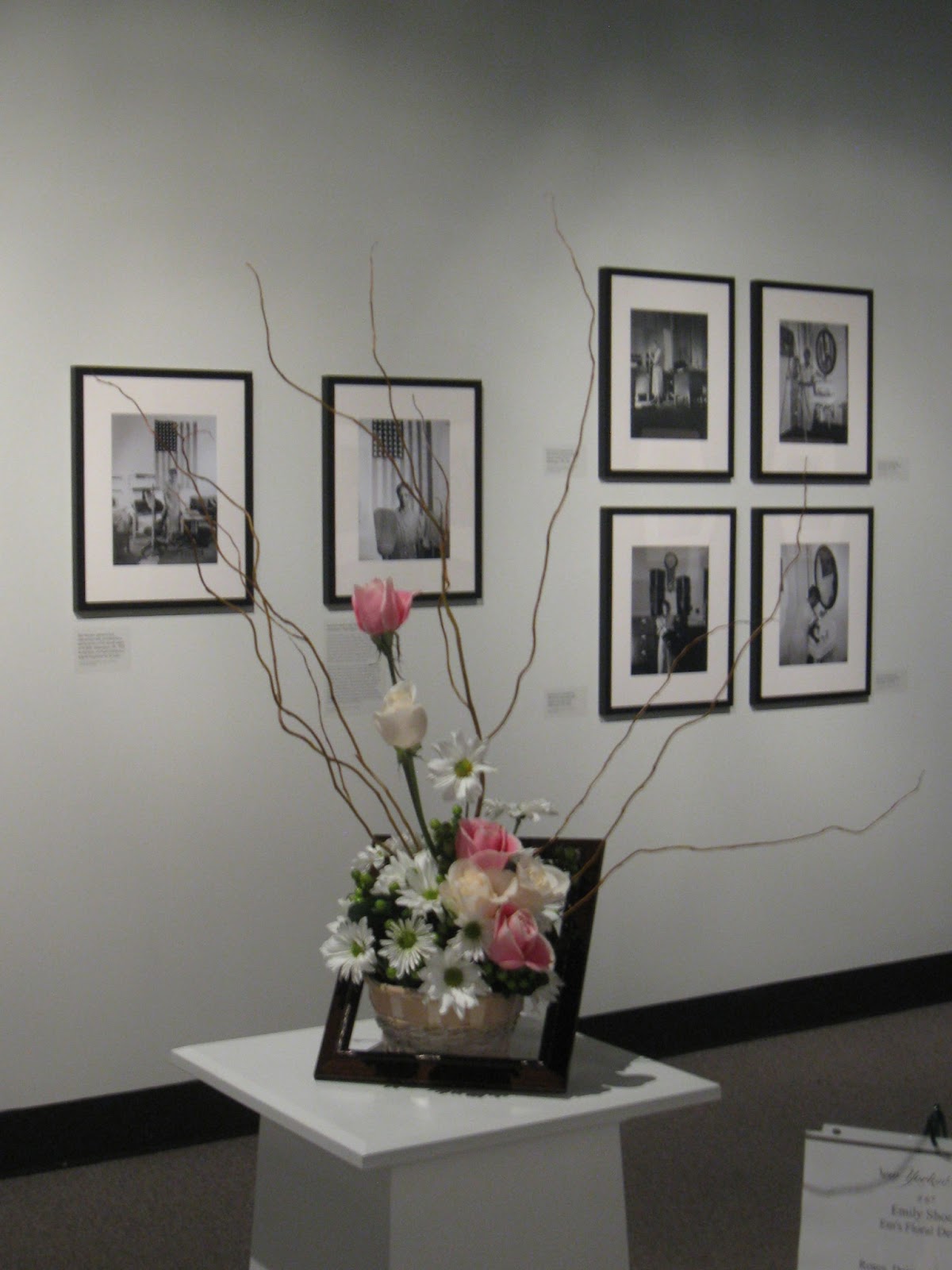
At the moment, the Photography Gallery is home to Gordon Parks: 100 Moments (closes May 19, 2013), which features 100 photographs documenting African-American life in New York City and Washington, DC in the early 1940s.  The images are compelling -- see this exhibit if you can -- and Charles and Barbara Guyette of W&P Enterprises created an arrangement of arachnia orchid, curly willow, lily, broad leaf eucalyptus, safari sunset, and leucodendron that complements them beautifully.

This is another favorite.  Linda Savage of W&P Enterprises created it with alstromeria, eucalyptus, leather leaf fern, godetia, tea roses, roses, baby's breath, juniper, palm, mums, spider mums, asparagus fern, and curly willow.

New York in Bloom 2013, part one

New York in Bloom, the New York State Museum's annual fundraiser for its after-school programs, is being held this weekend.  Those of you who have been following this blog for a bit know that I'm a huge fan of this event, which brings some much-needed color and fragrance to a bleak month.  When it arrives, I stop blogging about records, digital preservation, and archives for a few days and devote a couple of days to writing about flowers and the exhibits created by my employer's sister institution. 

Those of you who know about New York in Bloom may also know that the Museum Club (8-13 years old) and Discovery Squad (14-18 years old) have given invaluable educational, social, and vocational support to young people from some of Albany's most hardscrabble neighborhoods.  Each and every Discovery Squad student has graduated from high school -- no small accomplishment given that Albany High School's 2011 graduation rate was an appalling 52.3 percent -- and 92 percent have been admitted to college.  If you're going to be in the Albany area tomorrow, please consider attending New York in Bloom and supporting these fine programs.

This is the fourth year I've blogged about New York in Bloom, and I have to say that the floral arrangements, which are created by floral designers, students, garden clubs, and individual hobbyists, are a little less extravagant than in years past.  For example, the Bird Hall, which in past years was home to sextets of mammoth floral roomscapes, is completely devoid of arrangements this year.  However, the stunning "Once Upon a Time" arrangement that David Michael Schmidt of Renaissance Floral Design created for the main lobby of the Cultural Education Center (which houses the State Archives and State Library as well as the State Museum) is one of the lushest and most ornate things I've ever seen.

This fairy tale-themed installation features several artifacts from the State Museum's collections, including a flax wheel made ca. 1830 by R. Werdon.

Note the bitten apple to the left of the "carriage," which is actually a 19th-century glass hearse that was formerly part of a private collection in Greenville, New York.

The glass slipper and gown were created for the now-defunct New York Theater Institute, which used them in several early 21st-century productions.


My photographs of this display really don't do justice to this installation, but this professionally produced video documenting its creation most certainly does.


The State Museum sometimes uses the corridor leading to the West Gallery to exhibit a large artifact or grouping of photographs, but at the moment the corridor is devoid of any exhibit materials.  As a result, the arrangements placed there really pop out.  Holly Hemming of Felthausen's Florist created this very springlike arrangement of liatris, iris, blue hydrangea, button mums, and blue delphinium.

Friday, February 22, 2013

San Jose State SLIS colloquia

Every semester, San Jose State University's School of Library and Information Science offers a series of online colloquia that is freely accessible to anyone with an Internet connection and a modest array of hardware and software.  Information about the spring 2013 series has apparently been up for a bit, but I've been out of grad school so long that I've lost my once-profound connection to the rhythms of the academic calendar.  However, there's nothing like being appointed to a brand-new Staff Development Team to focus one's mind on free continuing education possibilities . . . .

Several of this semester's colloquia will be of interest to electronic records archivists and other information professionals seeking to preserve born-digital content.  Three of them will take place next week, and the fourth will occur in April:

Looking Back on the Preserving Virtual Worlds Projects
Henry Lowood, Curator for History of Science & Technology Collections and Film & Media Collections in the Stanford University Libraries 
Monday, 25 February 2013, 6:00-7:00 PM PST
This colloquium will be held in SJSU SLIS's Second Life virtual campus.  (You will need to establish a Second Life account and learn the basics of finding SLIS's "island" in order to attend.)

Digital Preservation for the Rest of Us: What's in it for Librarians and Library Users
Philip Gust, Stanford University -- Lots of Copies Keep Stuff Safe (LOCKSS) program
Tuesday, 26 February 2013, 12:00-1:00 PM PST
This colloquium will be held online via Collaborate Web conferencing (set-up info)

The Next Major Challenge in Records Management is Already Here: Social Media
Anil Chawla, Founder & CEO, ArchiveSocial
Tuesday, 26 February 2013, 6:00-7:00 PM PST
This colloquium will be held online via Collaborate Web conferencing (set-up info)

Professional Ethics for Records and Information Professionals
Norman Mooradian, VP of Information and Compliance, CookArthur Inc. 
Tuesday, 16 April 2013, 6:00-7:00 PM PST
This colloquium will be held online via Collaborate Web conferencing (set-up info)

If scheduling conflicts keep you from taking part in a colloquium you wish to attend, don't worry:  SLIS regularly posts Webcasts of completed colloquia on its website.

Friday, February 8, 2013

Winter's a quiet season

Just a quick note of apology for the recent absence of posts. I've been doing tons of research and writing at work -- compelling research and, I think, good writing -- and my batteries are depleted by the time I get home.  Mix in a personal life that's a little more chaotic than usual and an unusually persistent case of the winter blahs, and you've got a decent recipe for Blogging Malaise.

I've got a couple of job postings that really should go up soon, an almost-finished post about BeyoncĂ© (yes, BeyoncĂ©) that I hope to wrap up sometime this weekend, and a whole laundry list of interesting things that I want to share with you.  Given that Albany, New York is slated to have 10-14 inches of snow on the ground by tomorrow morning, I'll probably alternate between shoveling snow and shoveling away at least a little bit of the blog backlog.

And, of course, the 22nd New York in Bloom is almost here.  Those of you who are familiar with this blog know that I'm a huge fan of this New York State Museum event, but I usually manage to keep my enthusiasm in check until right before it opens.  Not this year.  All I want is to be surrounded by blooms and the smell of fresh-cut greenery.

If you're currently in the northeastern United States, I hope that you're someplace safe and warm and that you don't have to go anywhere for quite some time.  And if you're anywhere else, I hope that you are safe, warm, and having a nice weekend.

Image:  View of snowy path through Washington Park, Albany, New York, 26 November 1923.  New York State Education Dept., Division of Visual Instruction, Instructional lantern slides, 1911-1925, New York State Archives series A3045-78, lantern slide DnAkD8. Image courtesy of the New York State Archives.

Friday, December 7, 2012

Best Practices Exchange, day three


 The 2012 Best Practices Exchange (BPE) ended late yesterday morning, and my colleague Michael and I did some sightseeing in Annapolis before making the long drive back to Albany.  I'm sleep-deprived and still processing everything I learned, so this post is going to highlight some of the insights that Martha Anderson, the Director of Program Management at the Library of Congress's National Digital Information Infrastructure Preservation Program, shared during yesterday's plenary presentation:
  • In a digital world, "selection is rocket science."  We can't preserve everything, and we have to focus our efforts on saving only those things that are truly worth saving.
  • Over the past decade, we've developed a  wide array of good digital preservation tools and processes.  Now, we have to assemble them in ways that meet our local needs.  Wanting one tool to do everything is not realistic.
  • Archivists, librarians, curators, and other people who are trying to preserve digital content are running a relay race, and we should focus more on making sure that we're able to keep our digital content intact and accessible until the next generation of tools and processes emerge (or the next generation of cultural heritage professionals takes our place) and less upon the need to preserve our content  "until the end of time" or "forever."  Thinking of preservation as a ceaseless, ever-present responsibility can induce paralysis.  (It's also unrealistic.  A few years ago, I was chatting with a wise colleague and for some reason started bemoaning the lack of digital preservation solutions that would, in one fell swoop, enable me to stabilize a given set of records long enough to pass responsibility for their care on to the next generation of archivists.  I mentioned that the title of one superb resource -- the Digital Preservation Management:  Implementing Short-Term Solutions for Long-Term Problems workshop and tutorial -- highlighted the problem that electronic records archivists faced, and she looked at me, laughed, and said:  "Short-term solutions for long-term problems?  In other words, digital preservation is just like life.  What makes you think it would be otherwise?")
  • Our British colleagues are more adept than we are at casting their digital preservation needs in terms of the advantages preservation provides to business.  We can learn from them.
  • Earlier this week, influential Internet industry experts Mary Meeker and Liang Wu released a report asserting, among other things, that younger people are moving toward an "asset-light lifestyle." They think in terms of services -- online streaming of music and video, online access to publications and other information, Web services that enable sharing of cars and other durable goods -- instead of physical objects that they will purchase and maintain.  As yet, we don't know what the implications of this shift will be.  Will we move from a culture that views its heritage in thrifty terms or one that views its heritage as an abundance?  Will our next big challenge be selection of content, or will it be provision of access to content?
  • One of the biggest challenges we face when trying to find the resources needed to preserve digital content is our own unwillingness to ask difficult questions.  What are we doing that isn't good for our organization but somehow affirms someone's job?  How can we redirect energy and talent?  How can we use what we have in better ways?
Image:  Rotunda of Bancroft Hall, the mammoth Beaux-Arts dormitory in which all midshipmen reside, United States Naval Academy, Annapolis, Maryland, 6 December 2012.  The gifts under the tree are for the Toys for Tots program overseen by the United States Marine Corps Reserve.

Thursday, December 6, 2012

Best Practices Exchange, day two


Yesterday was the second day of the 2012 Best Practices Exchange, and the sessions I attended were delightfully heavy on discussion and information sharing. I had some problems accessing the hotel's wifi last night and the BPE is still going on, so I'm going to post a few of yesterday's highlights before turning my attention back to this morning's discussion:
  • Arian Ravanbakhsh, whose morning plenary speech focused on the Presidential Memorandum - Managing Government Records and U.S. National Archives and Records Administration (NARA) efforts to implement it, made an important point that all too often gets overlooked: even though an ever-increasing percentage of records created government agencies are born-digital, government archivists will continue to accession paper records well into the future. Substantial quantities of paper federal records have extremely long retention periods and won't be transferred to NARA until the mid-21st century, and, judging from the nodding heads in the audience, most state government archivists (l'Archivista included) anticipate that they'll continue to take in paper records for at least several more decades. Sometimes, I forget that we as a profession will have to ensure that at least two future generations of archivists have the knowledge and skills needed to accession, describe, and provide access to paper records. At the moment, finding new archivists who have the requisite interest and ability isn't much of a challenge -- sadly, archival education programs still attract significant numbers of students who don't want to work with electronic records -- but things might be quite different in 2030.
  • Butch Lazorchak of the Library of Congress highlighted a forthcoming grant opportunity: the Federal Geographic Data Committee, which is responsible for coordinating geospatial data gathering across the federal government and coordinates with state and local governments to assemble a comprehensive body of geospatial data, plans to offer geospatial archiving business planning grants in fiscal year 2013. The formal announcement should be released within a few weeks.
  • Butch also highlighted a couple of tools about which I was aware but haven't really examined closely: the GeoMAPP Geoarchiving Business Planning Toolkit, which can easily be adapted to support business planning for preservation of other types of digital content, the GeoMAPP Geoarchiving Self-Assessment, which lends itself to similar modifications, and the National Digital Stewardship Alliance's Digital Preservation in a Box, a collection of resources that support teaching and self-directed learning about digital preservation.
  • This BPE has seen a lot of discussion about the importance and difficulty of cultivating solid relationships with CIOs, and this morning one state archivist made what I think is an essential point: when talking to CIOs, archivists really need to emphasize the value added by records management and digital preservation. As a rule, we simply haven't done so.
  • This BPE has also generated a lot of ideas about how to support states that have yet to establish electronic records programs, and in the coming months you'll see the Council of State Archivists' State Electronic Records Initiative start turning these ideas into action. As a particularly lively discussion was unfolding this morning, it struck me that most of the people taking part in established full-fledged programs only after they had completed several successful projects; in fact, intense discussions about the challenges associated with transforming projects into programs took place at several early BPEs. If you don't have any hands-on electronic records experience and are facing resource constraints, it makes sense to identify a pressing but manageable problem, figure out how to solve it, and then move on to a few bigger, more complex projects.  After you've accumulated a few successes and learned from a few surprises or failures, you can focus on establishing a full-fledged program.
Image:  storm drain marker on Randall Street at City Dock, Annapolis, Maryland, 3 December 2012.

Tuesday, December 4, 2012

2012 Best Practices Exchange, day one


Today was the first day of the 2012 Best Practices Exchange (BPE), an annual event that brings together archivists, librarians, IT professionals, and other people interested in preserving born-digital state government information. The BPE is my favorite professional event, in no part because it encourages presenters to discuss not only their successes but also the ways in which unexpected developments led them to change direction, the obstacles that proved insurmountable, and the lessons they learned along the way.

As I explained last year, those of us who blog and tweet about the BPE are obliged to use a little tact and discretion when making information about the BPE available online. Moreover, in some instances, what's said is more important than who said it. As a result, I'm going to refrain from tying some of the information that appears in this and subsequent posts re: the BPE to specific attendees.

I'm also going to keep this post short. Our opening discussion began at 8:30, the last session ended at 4:45, and I was in a Persistent Digital Archives and Library System (PeDALS) meeting until almost 6:00. The PeDALS crew then hit the streets of Annapolis, Maryland. We started off with ice cream at the Annapolis Ice Cream Company (yum!), and then three of us split off from the group, rested a bit and caught up on the day's e-mail, and had dinner at the Ram's Head Tavern (also yum!) The BPE resumes tomorrow at 8:30, and I'm presenting at the end of the day, so I'm going to highlight the most interesting tidbits of information that I picked up today and then head to bed.

Doug Robinson, executive director of the National Association of Chief Information Officers (NASCIO) was this morning's plenary speaker, and he made a couple of really interesting points:
  • CIOs are juggling a lot of competing priorities. They're concerned about records management and digital preservation, but, as a rule, they're not worried enough to devote substantial attention or resources to improving records management or addressing preservation issues.
  • Cloud computing is now the number one concern of state CIOs, and CIOs are starting to think of themselves less as providers of hardware and software than as providers of services. Moreover, the cloud is attractive because it reduces diversity and complexity, which drive up IT costs. Robinson suspects that most states will eventually develop private cloud environments. Moreover, a recent NASCIO survey indicates that 31 percent of states have moved or plan to move digital archives and records management into the cloud.
  • CIOs are really struggling with Bring Your Own Devices issues and mobile technology, and the speed with which mobile technology changes is frustrating their efforts to come to grips with the situation. Citizens want to interact with state government via mobile apps, but the demand for app programmers is such that states can't retain employees who can create apps; at present, only one state has app programmers on its permanent payroll.
  • Cybersecurity is an increasingly pressing problem. States collect and create a wealth of data about citizens, and criminals (organized and disorganized) and hacktivists are increasingly interested in exploiting it. Spam, phishing, hacking, and network probe attempts are increasingly frequent. Governors don't always grasp the gravity of the threats or the extent to which their own reputations will be damaged if a large-scale breach occurs. Moreover, states aren't looking for ways to redirect existing resources to protecting critical information technology infrastructure or training staff.
  • Most states allocate less than two percent of their annual budgets to IT. Most large corporations devote approximately five percent of their annual budgets to IT.
I had the privilege of moderating one of the afternoon sessions, "Tearing Down the Borders: Coast-to-Coast Archives; Record-Keeping in the Cloud," in which Oregon State Archivist Mary Beth Herkert discussed her state's development of a cloud-based electronic records management system for state agencies and local governments, Bryan Smith of the Washington State Digital Archives detailed some of the Digital Archives' recent technical innovations. They then discussed their joint, National Historical Publications and Records Commission-funded effort to explore expanding Oregon's records management system to Washington State and ingesting Oregon's archival electronic records into Washington's Digital Archives.

I was really struck by Mary Beth's explanation of the cost savings Oregon achieved by moving to the cloud. In 2007, the Oregon State Archives was able to develop an HP Trim-based electronic records management system for its parent agency, the Office of Secretary of State. It wanted to expand this system, which it maintained in-house, to all state agencies and local governments, but it couldn't find a way to push the cost of doing so below $100 per user per month. However, the State Archives found a data center vendor in a small Oregon town that would host the system at a cost of $37 per user per month. When the total number of users reaches 20,000 users, the cost will drop to $10 per user per month.

Bryan made a couple of really intriguing points about the challenges of serving as a preservation repository for records created by multiple states.  First, partners who don't maintain technical infrastructure don't always realize that problems may be lurking within their digital content.  Washington recently led a National Digital Information Infrastructure Preservation Program (NDIIPP) grant project that explored whether its Digital Archives infrastructure could support creation of regional digital repository, and the problems that Digital Archives staff encountered when attempting to ingest data submitted by partner states led to the creation of tools that enable partners to verify the integrity of their data and address any hidden problems lurking within their files and accompanying metadata prior to ingest.

Second, the NDIIPP project and the current Washington-Oregon project really underscored the importance of developing common metadata standards. The records created in one state may differ in important ways from similar records created in another state, but describing records similarly lowers system complexity and increases general accessibility. Encoding metadata in XML makes it easier to massage metadata as needed and gives creators the option of supplying more than the required minimum of elements.

I'm going to wrap up this post by sharing a couple of unattributed tidbits:
  • One veteran archivist has discovered that the best way to address state agency electronic records issues is to approach the agency's CIO first, then speak with the agency's head, and then talk to the agency's records management officer. In essence, this archivist is focusing first on the person who has the biggest headache and then on the person who is most concerned about saving money -- and thinking in terms of business process, not records management.
  • "If you're not at the table, you're going to be on the menu."
Image:  Maryland State House, Annapolis, Maryland, 4 December 2012.  The State House, which was completed in 1779, is the first state capitol building completed after the American Revolution, the oldest state capitol that has been in continuous legislative use and the only state house that has an all-wooden dome.